+91-9866908086, +91-9494138086

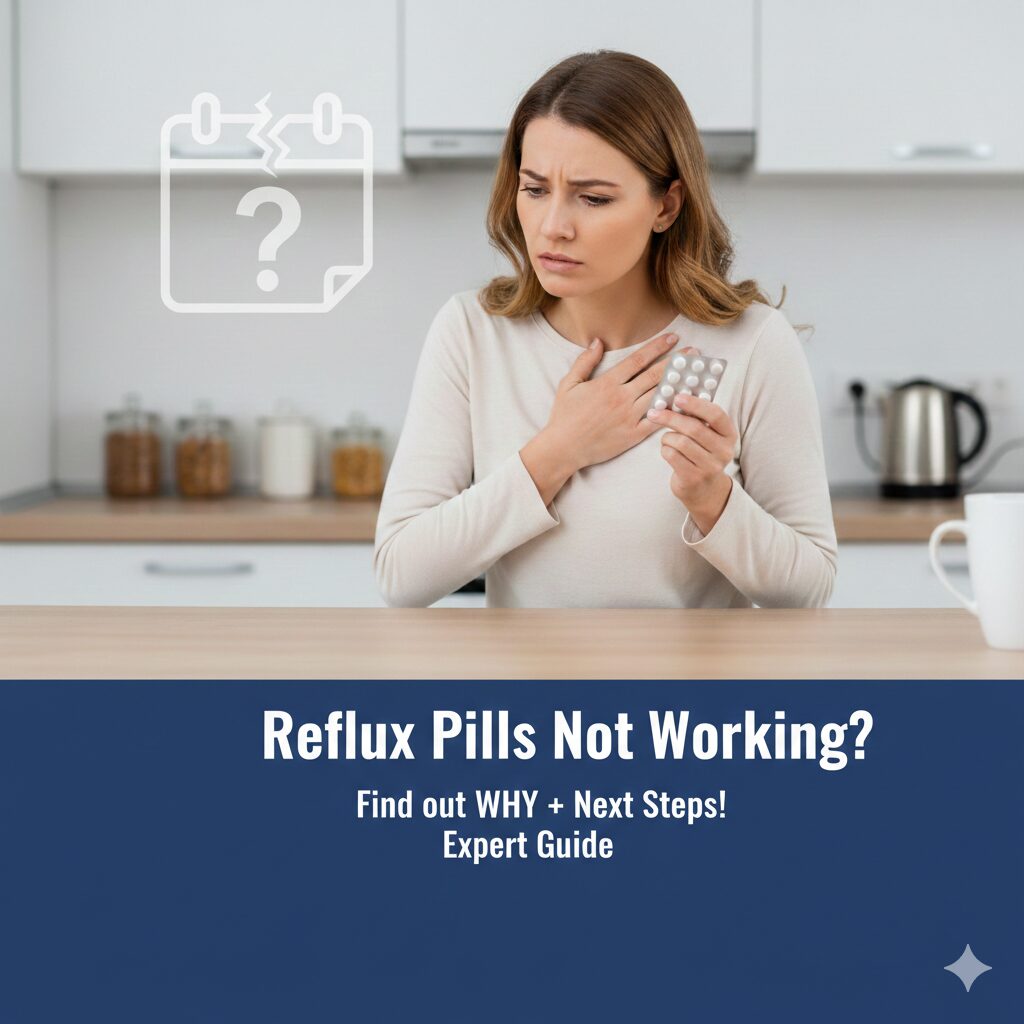
Why Your Acid Reflux is Not Improving With Medicines? What Can Be Done?
Contents of This Post:
- Is It Really Acid Reflux? The Risk of Misdiagnosis
- Are You Taking Your Medication Correctly?
- The Lifestyle Factors You Might Be Overlooking
- When the Stomach Isn’t the Only Problem: Structural Issues
- It Might Be “Non-Acid” Reflux
- Next Steps: Advanced Testing and Treatments
- Action Plan: What to Ask Your Doctor Today?
- Building a Healthier Future Together: A Pharma PCD Partnership for Patient Care
When the Daily Pill Isn’t Enough for Acid Reflux
You take your medication every single morning, just like your doctor advised. Whether it’s a little white tablet, a yellow capsule, or a teal-and-pink one, that daily dose is supposed to be your shield against the acidity, the heartburn, especially if you cannot start your day without your morning cup of tea or coffee, the ‘bed-tea’ habit in most Indian households.
By taking your medicine, you’ve done your part: you avoid the late-night snacks, you’ve cut back on tea and coffee, and you even sleep propped up on extra pillows. Yet, the familiar fire still creeps up your chest. Sometimes more, sometimes less, but it does not seem to be going away.
We understand that it is incredibly frustrating to follow the rules and still feel like your symptoms are winning. You might even start to wonder if the medicine has simply stopped working or if your condition is getting worse.
Up to 40% of people taking Proton Pump Inhibitors (PPIs) still experience symptoms. This is what doctors call “refractory GERD.” The truth is, simply taking a pill—regardless of its colour—isn’t always a “magic fix” if the underlying cause of your reflux remains unaddressed.
If your symptoms persist, it usually isn’t because the medicine is “broken.” It’s often because of how the medicine is taken, a structural issue in your body, or a misdiagnosis. Now, this guide will walk you through the real reasons your reflux isn’t improving and the active steps you can take to finally find relief.
Is It Really Acid Reflux? The Risk of Misdiagnosis
Before you blame the medication, you must ask a critical question: Are you actually treating acid reflux? Many people—and sometimes even doctors—assume any chest burn or throat irritation is Gastroesophageal Reflux Disease (GERD). However, several other conditions mimic these symptoms but do not respond to acid-blocking pills.
Conditions That Mimic Acid Reflux
If your pills aren’t working, you might be dealing with one of the following:
- Functional Dyspepsia: Firstly, it could be functional dyspepsia, a condition that causes pain in the upper abdomen and a feeling of fullness. While it feels like reflux, it often stems from nerve sensitivity in the stomach rather than actual acid backing up.
- Gastroparesis: Secondly, it could be gastroparesis that occurs when your stomach muscles move too slowly, preventing your stomach from emptying properly. The food sits there too long, creating pressure that feels like a burn. Moreover, standard reflux meds won’t speed up your stomach.
- Eosinophilic Esophagitis (EoE): Then, it could be EE, an allergic inflammatory condition of the oesophagus. It causes difficulty swallowing and chest pain that feels identical to heartburn, but it requires specific dietary changes or steroids rather than just acid blockers.
- Achalasia: Also, it could be achalasia, a rare disorder where the muscles in your oesophagus don’t push food down correctly.
- Heart Problems: Sometimes, heartburn may be actual angina pain which can seem similar to heartburn from acidity. But, any antacid or medicine you may take in such a condition will not relieve the heartburn.
Why Typical Medications Fail if the Diagnosis Is Wrong?
Most reflux treatments share a single goal: neutralising or stopping the production of stomach acid. However, if your symptoms stem from a different issue, these various drug classes will likely fail you.
- Antacids (e.g., Digene, Gelusil, Megabest, Megabest-O, Qfate-O, primarily containing ingredients such as aluminium/magnesium hydroxides, simethicone, and calcium carbonate for fast heartburn/acidity relief): These provide quick, temporary relief by neutralising existing acid. So, if your pain comes from a structural issue like a hernia, these will feel like “putting a Band-Aid on a broken bone.”
- H2 Blockers (e.g., Famotidine, Cimetidine, Ranitidine: Aciloc, Zinetac): Now, these reduce the signal to produce acid. So, they work well for occasional heartburn, but they cannot address “mechanical” reflux, where the valve between your stomach and oesophagus is physically too weak to stay closed.
- Proton Pump Inhibitors (PPIs) (e.g., Omeprazole, Pantoprazole, Esomperazole, Rabeprazole, Lansoprazole in brands like PanGERD, EsGERD, Nureal): Next are the PPIs, the most potent acid-blockers. While they are highly effective at healing an inflamed oesophagus, they do nothing to stop non-acid reflux. So, if bile or digestive enzymes are washing back into your throat, your “acid-free” stomach contents will still irritate.
- Alginates: Then, there are alginates that create a physical foam raft on top of your stomach contents. If your primary issue is gastroparesis (slow stomach emptying), the raft cannot stay in place because the sheer volume of food and pressure in the stomach overwhelms it.
So, you are essentially using the wrong tool for the job. If your pain comes from nerve hypersensitivity or a motility disorder, no amount of acid suppression will fix the way your muscles move or how your nerves perceive pain. If you have cycled through these different classes of medication with zero improvement, it is a major red flag that the “reflux” label might be incorrect.
Now, Let’s See If You Are Taking Your Medication for Acid Reflux Correctly.
You might assume that as long as the pill reaches your stomach, it will do its job. However, medications for acid reflux—especially Proton Pump Inhibitors (PPIs)—are highly sensitive to timing. So, if you take them at the wrong time, you may as well not take them at all.
The 30-Minute Rule With PPIs: Timing is Everything.
PPIs (like Omeprazole, Pantoprazole, Rabeprazole or Esomeprazole) do not neutralise acid that is already there. Instead, they shut down the “pumps” in your stomach cells before they start producing acid. These pumps are most active right after you eat. So, to work effectively, the medication needs to be in your bloodstream before those pumps turn on.
Firstly, understand the Golden Rule: Take your medication 30 to 60 minutes before your first meal of the day.
Secondly, avoid the Common Mistake: If you take your pill with your food or after you eat, the pumps have already fired. So, the medication will miss its window of opportunity, leaving you with little to no protection during the meal.

Consistency is Key: Why Skipping Doses Sabotages Relief?
Unlike aspirin for a headache, PPIs are not “rescue” medications. They often take three to five days of consistent use to reach their full effect.
So, if you only take the pill on days when you feel “extra reflux,” you aren’t actually suppressing acid production effectively.
Besides, stopping and starting the medication causes your stomach to fluctuate in acid levels, which can lead to “rebound acid hypersecretion”—a fancy way of saying your stomach produces even more acid to compensate. So, when your doctor prescribes a medicine, do not underestimate the time of taking the medicine, its frequency and duration (for how long you need to be taking it).
The Role of H2 Blockers and Antacids in Acid Reflux:
While PPIs require a strict schedule, other medications have different rules:
H2 Blockers (e.g., Famotidine): You can take these 15–60 minutes before a meal that you know will trigger symptoms, or even at bedtime to prevent night-time reflux.
Antacids: These work best after symptoms start or right before bed, but they interfere with the absorption of other medicines. So, if you take an antacid at the same time as your PPI, you might actually prevent the PPI from working correctly.
The Action Point: Now, check your routine. If you have been taking your medication haphazardly or right as you sit down to breakfast, try the “30-minute before” rule for one week. You might find the medicine works exactly as intended when given the right head start.
The Lifestyle Factors You Might Be Overlooking:
Medication can only do so much heavy lifting. So, if you rely solely on a pill while maintaining habits that physically force acid upward, your treatment will likely fail. Think of medication as a way to turn down the “heat” of the acid, while lifestyle changes stop the “overflow.”
Sleep Hygiene: The Impact of Late-Night Snacking and Flat Pillows on Acid Reflux
Gravity is your best friend—or your worst enemy—when it comes to reflux.
- Firstly, the Three-Hour Rule: If you eat a meal and then lie down immediately, you lose the benefit of gravity. A full stomach puts immense pressure on the Lower Esophageal Sphincter (LES), the valve meant to keep food down. So, you should finish your last meal at least three hours before bed to allow the stomach to empty.
- Secondly, the Incline Advantage: Sleeping flat on your back allows acid to pool in the oesophagus. So, propping yourself up with extra pillows often backfires because it only bends your neck or waist, increasing abdominal pressure. Instead, use a wedge pillow or elevate the head of your bed frame by six inches. This keeps your entire torso at an incline, using gravity to keep acid where it belongs.
- Finally, the Left Side Secret: Studies show that sleeping on your left side reduces reflux episodes. Because of the stomach’s natural curve, lying on the left keeps the gastric juices below the entry point to the oesophagus.
Stress and the Gut: How Anxiety Triggers Your Acid Reflux Symptoms?
The brain and the gut stay in constant communication via the vagus nerve. When you are stressed or anxious, your body enters “fight or flight” mode, which can wreak havoc on your digestion.
- Firstly, Heightened Sensitivity: Stress doesn’t necessarily make you produce more acid, but it makes your oesophagus hyper-sensitive. This means even a normal, tiny amount of reflux—which wouldn’t bother most people—feels like a painful burn to someone under high stress.
- Secondly, Delayed Digestion: Anxiety can slow down your stomach’s emptying process (motility). [Ref.] Then, if food sits in your stomach longer due to stress, the risk of it refluxing upward increases significantly.
Physical Pressure: The “Tight Belt” Effect
Sometimes the issue is purely mechanical. If you wear tight clothing or carry extra weight around your midsection, you create “intra-abdominal pressure.” This pressure physically squeezes the stomach, forcing its contents past the LES valve. So, transitioning to looser clothing or focusing on core-safe weight management can often provide more relief than an extra dose of medicine.
When the Stomach Isn’t the Only Problem?
Structural Issues That May Be The Big Reason for Acid Reflux Medicines Not Working
Sometimes, your anatomy (how your body is physically), may be the reason your acidity medicines are not working. If the physical “plumbing” of your digestive system is compromised, changing the chemical composition of the fluid (by removing acid) won’t stop the leak. It merely changes what is leaking. So, if you have a structural defect, medication often fails because it cannot physically tighten a valve or pull your stomach back into place.
The Role of Hiatal Hernias in Medication Resistance
The diaphragm acts as a secondary barrier against reflux. It pinches the oesophagus to help keep the stomach closed. However, in many people, the upper part of the stomach pushes up through the diaphragm and into the chest cavity. This is a hiatal hernia.
When this happens, the stomach loses the support of the diaphragm. So, acid gets trapped in the “hernia sac” above the diaphragm, allowing it to easily flow back into the oesophagus.
The Problem: Medication reduces the acidity of the liquid, but it does not fix the hernia. So, the liquid—now although less acidic but still irritating—continues to splash up because the mechanical barrier is gone.
The Symptom: You might feel regurgitation (liquid coming up) even if it doesn’t “burn” as intensely as before.
Understanding a Weak Lower Oesophageal Sphincter (LES)
The Lower Oesophageal Sphincter (LES) is the muscular ring that acts as a gatekeeper between your throat and your stomach. In a healthy person, it opens to let food down and snaps shut to keep acid down.
For many sufferers, this muscle becomes “hypotensive,” meaning it is too weak to stay closed against the pressure of the stomach.
Firstly, let us take a look at the triggers: Certain foods (like chocolate, peppermint, and caffeine) and habits (like smoking) chemically relax this muscle further.
Now, the reality: No pill on the market currently tightens the LES. While some older drugs attempted this, they had severe side effects and were removed from the market. This also highlights an area of opportunity for our scientists, researchers and pharmacists to study, research and develop medicines that can safely and effectively tighten LES. If your LES is permanently weak (incompetent), acid blockers will reduce the burn, but they will never stop the reflux event itself.
Finally, the action point: If you experience “volume reflux”—where you physically feel liquid or food coming up into your throat when you bend over or lie down—it is likely a mechanical issue. So, you need to discuss structural testing (like an endoscopy or barium swallow) with your doctor.
It Might Be “Non-Acid” Reflux
Patients often use the terms “reflux” and “acid” interchangeably. But they are not the same thing. “Reflux” simply means fluid moving backwards. While stomach acid is the most common culprit, it is not the only fluid that can wash up into your oesophagus.
If you have completely suppressed your stomach acid with high doses of medication but still feel a burning or gnawing pain, you might be suffering from Bile Reflux.
When Bile, Not Acid, Causes the Burn
Bile is a greenish-yellow digestive fluid produced by the liver and stored in the gallbladder. Its job is to break down fats in the small intestine.
In a healthy digestive system, a valve called the pylorus (located at the bottom of your stomach) opens to let food out and closes to keep bile in the small intestine. However, if this valve is weak or damaged (common after gallbladder removal or gastric surgery), bile can backwash into the stomach. Once in the stomach, it mixes with food and eventually refluxes up into the oesophagus.
Why Proton Pump Inhibitors (PPIs) Cannot Stop Bile Reflux?
This is the critical “Aha!” moment for many patients.
Firstly, see how PPIs work: They target specific “proton pumps” in your stomach cells that create hydrochloric acid.
Now, the limitation: Bile is alkaline, not acidic. So, it does not come from proton pumps. Therefore, taking an acid blocker has zero effect on bile.
If you have bile reflux, taking a PPI is like turning off the water faucet when your house is flooding from a burst pipe in the basement—you are targeting the wrong source. The medication removes the acid, but the bile continues to splash up, irritating the oesophageal lining and causing gastritis (stomach inflammation).
Signs it might be Bile:
- Firstly, you have a persistent bitter or metallic taste in your mouth.
- Secondly, you experience nausea or vomiting of greenish-yellow fluid.
- Besides, you feel a burning pain in the upper middle stomach that doesn’t improve with antacids.
Next Steps: Advanced Testing and Treatments
If you have tried the lifestyle changes, fixed your medication timing, and still feel miserable, it is time to stop guessing and start measuring. An endoscopy (where a camera looks at your throat) is a good start, but it often misses the “invisible” problems like weak muscles or non-acid reflux. You may need functional testing to see how your system works, not just what it looks like.
Going Beyond the Endoscopy: pH Monitoring and Manometry
Your doctor may recommend these tests to find the root cause:
- Oesophageal Manometry: This test measures the strength and coordination of your oesophageal muscles. So, it answers the question: Is your swallowing mechanism weak? And for this, a thin tube is passed through the nose to measure the pressure of your muscle contractions. This is the gold standard for diagnosing motility disorders like Achalasia.
- 24-Hour pH Impedance Monitoring: This is the most accurate test for refractory reflux. A small catheter measures the amount of acid and non-acid liquid (like bile) coming up your throat over a full day. So, it can tell you if your symptoms actually correlate with reflux episodes or if you are feeling pain when no reflux is happening (hypersensitivity).
- Bravo pH Capsule: A wireless alternative to the catheter. A small capsule is pinned to your oesophagus during an endoscopy and sends pH data to a receiver on your belt for 48 to 96 hours.
Surgical and Endoscopic Solutions to Consider
If tests confirm a mechanical defect like a large hernia or a weak valve, surgery might be the only way to get off medication.
- Nissen Fundoplication: The traditional surgery where the top of the stomach is wrapped around the lower oesophagus to tighten the valve. It creates a new, high-pressure barrier against reflux.
- LINX Device: A newer, less invasive option where a ring of magnetic titanium beads is placed around the LES. The magnets hold the valve closed to stop reflux but expand to let food pass through.
- TIF (Transoral Incisionless Fundoplication): An endoscopic procedure that rebuilds the valve from the inside, requiring no incisions. So, it is a good middle ground for patients who want to avoid major surgery but need a mechanical fix.
- The Reality Check: Surgery is a big step. So, it is generally reserved for people who have a confirmed mechanical defect (like a hernia) or who respond well to medication but cannot take it long-term due to side effects. It is rarely the first choice for “sensitive” stomachs.
Action Plan: What to Ask Your Doctor Today?
You shouldn’t have to live with a “fire in your chest” indefinitely. So, if you have followed your treatment plan and still feel no relief, it is time to advocate for yourself. General practitioners often treat reflux with a “trial and error” approach, but when that fails, you need specific answers.
So, use your next appointment to move beyond the standard prescription. Take this list of questions to your doctor to steer the conversation toward a more precise diagnosis:
“Is my diagnosis confirmed?” Firstly, ask if your symptoms could actually be functional dyspepsia, gastroparesis, nerve hypersensitivity or something else.
“Could this be non-acid reflux?” Next, ask about the possibility of bile reflux, especially if you have had your gallbladder removed or feel bitter tastes in your mouth.
Then, “Is there a structural issue?” Ask for a barium swallow or a repeat endoscopy to specifically check for a hiatal hernia or a weak LES valve.
Then, “Can we perform functional testing?” If pills aren’t working, request a referral for Oesophageal Manometry or pH Impedance Monitoring. These tests prove whether the medicine is actually failing or if the problem isn’t acid at all.
Finally, “Should I see a specialist?” If you aren’t already seeing a gastroenterologist who specialises in “foregut” or “motility” issues, now is the time to ask for that referral.
Reflux medication is a tool, not a cure. So, if the tool isn’t fixing the problem, don’t just “press harder” by taking more pills. Instead, look at the timing, examine your habits, and investigate the physical structure of your digestive system.
When you address the why behind your symptoms, you stop managing the burn and start reclaiming your life.
Building a Healthier Future Together: A Pharma PCD Partnership for Patient Care
At our core, we believe that no patient should suffer in silence simply because high-quality healthcare is out of reach. We understand that effective acid reflux management requires more than just a prescription—it requires reliable, scientifically formulated medications that healthcare providers can trust and patients can afford.
Our mission extends beyond the laboratory. Besides, we aim to bridge the gap between advanced pharmaceutical research and the communities that need it most. To achieve this, we are looking for dedicated business partners who share our commitment to medical ethics and patient-centric care.
Why Partner With Us At Best Biotech?
We offer lucrative business opportunities for Pharmaceutical Stockists, Retailers, Pharmacists, Pharma PCD Partners, and Industry Professionals across all regions. We provide:
- Exclusive Monopoly Rights: Firstly, we secure your territory and grow your business with confidence.
- PCD and Franchise Models: Secondly, you can benefit from a structured, supportive partnership designed for mutual growth.
- Ethical Marketing Support: Finally, we provide the promotional tools and high-quality products you need to build a reputable presence in the healthcare market.
Let’s work together to ensure that every pharmacy shelf and clinic has access to the right solutions for gastric health. By joining our network, you aren’t just building a business—you are helping patients reclaim their lives from chronic discomfort.
Contact Us Today to Discuss Partnership Opportunities
Product Reference Guide & Usage Tips
Below is our comprehensive portfolio of gastric health solutions. We have categorised these by drug class to help you understand their specific roles in treatment.
| Brand Name | Composition | Class / Category | Usage Tips for Effective Relief |
| PanGERD-40 | Pantoprazole 40mg (Tablets) | PPI (Acid Suppressant) | Take 30–60 mins before breakfast. |
| PanGERD-IV | Pantoprazole 40mg (Inj) | PPI (Injectable) | For acute hospital/clinical use only. |
| PanGERD-DSR | Pantoprazole 40mg + Domperidone 30mg SR (Capsules) | PPI + Prokinetic | Best for reflux with bloating/nausea for sustained results. |
| PanGERD-D | Pantoprazole 40mg + Domperidone 10mg (Tablets) | PPI + Prokinetic | Best for reflux with bloating/nausea. |
| PanGERD-HP Kit | Each kit contains Amoxicillin 750 mg(2 tabs)+Clarithromycin 500mg (2 tabs)+Pantoprazole 40mg(2 capsules) | H. Pylori Treatment (Antibiotics + PPI) | Complete kit for treating bacterial ulcers. |
| PanGERD-IT | Pantoprazole Sodium 40mg + Itopride Hydrochloride 150mg capsules (Capsules) | PPI + Prokinetic | Helpful for motility-related reflux. |
| PanGERD-LSR | Pantoprazole 40mg + Levosulpiride 75mg (Capsules) | PPI + Prokinetic | Helpful for motility-related reflux. |
| PanGERD-CT | Pantoprazole 40mg + Cinitapride 3mg (Capsules) | PPI + Prokinetic | Targets slow stomach emptying. |
| EsGERD-40 | Esomeprazole 40mg (Capsules) | PPI (Potent Suppressant) | Ideal for healing erosive esophagitis. |
| EsGERD-IV | Esomeprazole 40mg (Inj) | PPI (Injectable) | Used for rapid acid control in clinics. |
| EsGERD-DSR | Esomeprazole 40mg + Domperidone 30mg SR (Capsules) | PPI + Prokinetic | Provides sustained relief from reflux. |
| EsGERD-L | Esomeprazole 40mg + Levosulpiride 75mg (Capsules) | PPI + Prokinetic | For severe reflux and dyspepsia. |
| EsGERD-HP Kit | Esomeprazole + Clarithromycin + Amoxicillin (Capsules) | H. Pylori Treatment (PPI + Antibiotics) | Complete kit for treating bacterial ulcers. |
| Nureal | Rabeprazole 20mg (Tablets) | PPI (Fast-Acting) | Provides fast-acting acid suppression. |
| Nureal-DSR | Rabeprazole 20mg + Domperidone 30mg (Capsules) | PPI + Prokinetic | Relieves gas and reflux simultaneously. |
| Nureal-LSR | Rabeprazole 20mg + Levosulpiride 75mg (Capsules) | PPI + Prokinetic | For reflux with significant stomach heaviness. |
| Nureal-DS VG | Rabeprazole Sodium 20mg (Enteric coated pellets)+Domperidone 30mg (Sustained Release Pellets) in Vegetarian Capsules | PPI + Prokinetic | For reflux with significant stomach heaviness. For patients on Vegan diet or who are concerned about vegetarian-friendly options. |
| OM PPI-DS | Omeprazole 20mg + Domperidone 30mg (Capsules) | PPI + Prokinetic | A standard combination for daily relief. |
| OM PPI Fast | Omeprazole 20mg + Sodium bicarbonate 600mg + Magnesium hydroxide 700mg in powder form (Sachets) | PPI + Antacids | For rapid and lasting relief from acid reflux and heartburn. |
| MEGABEST(Elaychi flavour) MEGABEST (Orange flavour) | Magaldrate 480mg + Simethicone 20mg | Antacid + Antiflatulent | Take after meals for instant cooling. |
| MEGABEST-O | Magaldrate 540mg + Oxetacaine 10mg + Simethicone 50mg | Antacid + Local Anesthetic | Oxetacaine numbs the throat/stomach pain. |
| MEGABEST-DM | Magaldrate 480mg + Simethicone 20mg Domperidone 10mg / 5 ml | Antacid + Local Anesthetic + Prokinetic | Numbs stomach pain, relieves nausea and heartburn. |
| MEGABEST-3X (Sugar Free) Peppermint flavour | Sodium Alginate 250mg + Sodium Bicarbonate 133.5mg + Calcium Carbonate 80mg/5ml Suspension | Alginate + Antacid | Creates a physical foam raft on top of stomach contents, delays gastric emptying |
| QFATE-O | Sucralfate 1gm + Oxetacaine 20mg | Mucosal Protective | Coats ulcers and protects the lining. |
General Tips for Best Results:
- Firstly, Empty Stomach First: Always take PPI-based capsules (PanGERD, EsGERD, Nureal, OM PPI) on an empty stomach, preferably 30–60 minutes before your first meal.
- Secondly, Separate Liquid Meds: If using MEGABEST or QFATE-O alongside a PPI, wait at least 2 hours between doses because antacids can interfere with the absorption of the daily tablet.
- Thirdly, Finish the Course: Even if you feel better after two days, finish the full course prescribed by your doctor to ensure the oesophageal lining heals completely.
- Finally, Avoid Late Doses: Do not take prokinetic combinations (DSR/LSR) right before sleep unless specified; they work best when taken before meals to help food move downward.
Business queries welcome. Also, you can follow us on Instagram and Facebook to get regular insights on health and wellness. Join our WhatsApp channel to get an instant update on What’s New.
⚠️ Disclaimer: The content provided in this post is for educational purposes only. It is not a substitute for professional medical advice. All medicines listed or discussed should be taken strictly under the advice and prescription of a registered medical practitioner. Do not self-medicate.
Quick Links:
- Can WIKLYONE (Trelagliptin) Reduce the Diabetes Burden in India?
- Best Biotech India – PCD Pharma Franchise in Assam
- “India’s AQI is Redlining: Protecting Your Lungs with Science, Strategy, and Immunity”
- Struggling with the Mucus and Wheeze of COPD? Why Targeting Both Can Be a Game Changer
- WIKLYONE: Life-Changing First-of-its Kind Diabetes Medicine
One thought on “Why Your Acid Reflux is Not Improving With Medicines? What Can Be Done?”