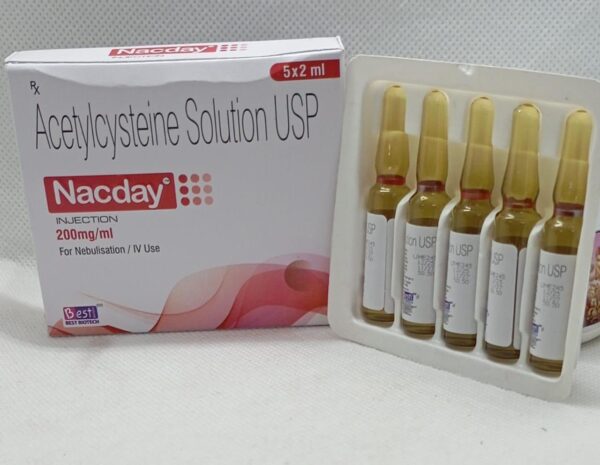
NACDAY Injection

Composition:

Acetylcysteine 200mg/ml – Aqueous Base

Pack Type:

5 X 2 ml (Tray)

Short Discription:

Concentrated Acetylcysteine 200mg/ml IV injection for severe respiratory mucolysis, paracetamol toxicity antidote, and ICU critical care support.

  Nacday Injection (Soqute Division) is a potent, high-concentration formulation of Acetylcysteine (200 mg/ml in an aqueous base) engineered for rapid action in critical care, pulmonary, and emergency medical settings. Functioning as both a powerful mucolytic agent and a vital cellular antioxidant, Nacday Injection plays a essential role in clearing severe bronchial secretions and protecting vital organs from acute oxidative injury. Formulated for intravenous administration, Nacday Injection provides immediate bioavailability in hospital and ICU environments. It effectively breaks down hyper-viscous mucus in acute bronchopulmonary conditions, restores depleted hepatic glutathione during acute acetaminophen (paracetamol) toxicity, and supports pulmonary function in critically ill patients under intensive care.

Acetylcysteine 200 mg/ml aqueous base is a clinically proven mucolytic solution used in the management of respiratory conditions associated with thick and tenacious mucus. It helps reduce mucus viscosity and supports improved airway clearance when used as directed by a healthcare professional.

Acetylcysteine 200 mg/ml works by breaking disulfide bonds in mucoproteins, thereby reducing the thickness and stickiness of respiratory secretions. This action helps patients expel mucus more easily and improves ventilation in obstructive airway conditions.

The aqueous base formulation of Acetylcysteine 200 mg/ml ensures faster dispersion and effective delivery, especially when administered through inhalation or nebulization under medical supervision. It is commonly used as supportive therapy in both acute and chronic respiratory disorders.

Regular use of Acetylcysteine 200 mg/ml as prescribed may help maintain airway hygiene, reduce mucus-related discomfort, and support overall respiratory function.

How Acetylcysteine 200 mg/ml Works

  • Breaks down thick and sticky mucus

  • Reduces mucus elasticity and adhesiveness

  • Enhances mucociliary clearance

  • Improves airflow and respiratory efficiency

Why Aqueous Base?

  • Faster mucolytic action

  • Better patient tolerability

  • Suitable for nebulization

  • Ensures uniform drug delivery

  • Mucolytic Action (Disulfide Bond Cleavage): Directly breaks the disulfide linkages of mucoproteins in pulmonary secretions. This reduces sputum viscosity, liquefies dense mucus plugs, and restores tracheobronchial clearance in compromised airways.
  • Glutathione Replenishment & Hepatic Protection: Serves as a direct precursor to L-cysteine, an essential substrate in the synthesis of intracellular Glutathione (GSH). In cases of paracetamol overdose, it rapidly restores depleted glutathione stores, neutralizing the toxic metabolite NAPQI and preventing irreversible hepatic necrosis.
  • Free Radical Scavenging: Acts as a direct scavenger of reactive oxygen species (ROS), mitigating tissue damage, endothelial dysfunction, and systemic inflammatory cascades in acute respiratory distress and sepsis.
  • Acute and chronic bronchopulmonary disorders with abnormally viscous mucus (COPD, Severe Bronchitis, Cystic Fibrosis, Atelectasis due to mucous obstruction)
  • Antidote for acute Acetaminophen (Paracetamol) toxicity and overdose
  • Critical care / ICU support for Acute Respiratory Distress Syndrome (ARDS) and pulmonary complications
  • Prophylaxis against Contrast-Induced Nephropathy (CIN) in high-risk patients undergoing radiocontrast procedures

Administration: For Intravenous (IV) Infusion or IV Injection after suitable dilution with compatible intravenous fluids (e.g., 5% Dextrose or Normal Saline).

Dosage: Varies significantly based on the clinical indication (e.g., mucolytic therapy vs. paracetamol overdose antidote protocols).

Strictly reserved for hospital/institutional use. Must be administered by or under the direct supervision of a Registered Medical Practitioner or Critical Care Specialist.