
Contents of This Post:
- The Grim Reality: It’s Not Just a Cough
- The Winter Trap: Why Pollution Hits Harder as Temperatures Drop?
- Your Immediate Strategy: The Individual Shield
- Medical Preparedness: Our First Line of Defence A Call to the Pharmaceutical Industry: Join the Mission
- A Call to the Pharmaceutical Industry: Join the Mission
The headlines across India today read like a medical emergency bulletin. What we once called “winter fog” has officially transitioned into a lethal chemical blanket.
“Delhi Records Over 200,000 Acute Respiratory Illness Cases in 3 Years”
“India Accounts for 26% of Global Deaths Linked to Air Pollution”
The Lancet Countdown, Oct 2025
“COPD Now India’s Second Leading Killer as Non-Smokers Flood Clinics”
As the Air Quality Index (AQI) “redlines” into the “Severe” and “Hazardous” categories, we are no longer just breathing; we are battling. Recent data from the State of Global Air (SoGA) 2025 report reveals a staggering 2 million lives lost to pollution-related diseases in India in a single year.
We cannot solve the air crisis overnight. But we can—and must—prepare our bodies to survive it. Is Your Family Prepared for India’s “Severe” AQI?
The Grim Reality: It’s Not Just a Cough
Pollution isn’t just about hazy skies; it’s a systemic attack on our health. Recent government data from December 2025 reveals that six major hospitals in Delhi alone recorded over 200,000 acute respiratory illness cases between 2022 and 2024.
When the sky turns a dull, metallic grey and the air smells of burning rubber, the immediate symptoms seem manageable—a scratchy throat, watery eyes, or a persistent dry cough. Most of us dismiss these as “seasonal changes.” However, recent medical data suggests we are witnessing a systemic health collapse.
The surge is visible in every clinic. Doctors are reporting a 100% spike in patients requiring nebulization and respiratory support. Conditions like COPD (Chronic Obstructive Pulmonary Disease), once seen primarily in smokers, are now striking non-smokers and young adults. The air we breathe is effectively smoking cigarettes for us.
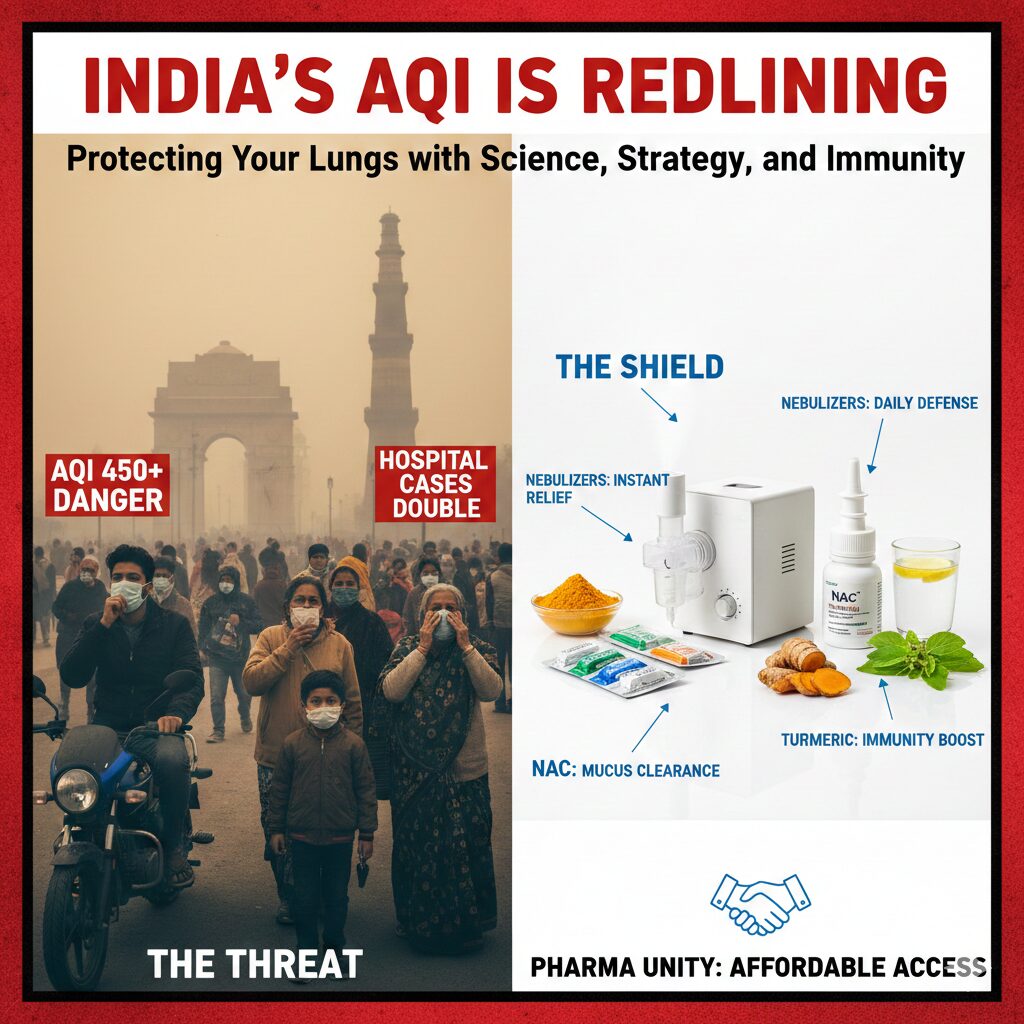
The “Silent Killer” Statistics:
The numbers for 2024 and 2025 paint a terrifying picture of the toll pollution takes on the Indian population:
- A Crisis of Numbers: According to recent data from The Lancet Planetary Health, air pollution now accounts for nearly 18% of all deaths in India.
- The Non-Smoker’s Burden: Clinical reports from 2025 show a 40% rise in lung cancer cases among non-smokers, directly attributed to prolonged exposure to PM2.5 particles.
- The Paediatric Emergency: A Business Standard (Nov 2025) report highlights that children now account for 43% of pollution-related insurance claims. Their developing lungs suffer irreversible scarring before they even reach adulthood.
- Beyond the Lungs: A Systemic Attack. We must stop viewing pollution as “just a respiratory issue.” When you inhale PM2.5—particles 30 times thinner than a human hair—they don’t just stay in your lungs. They cross the blood-air barrier and enter your bloodstream.
- Cardiac Redlining: High AQI levels trigger systemic inflammation, leading to a 20-25% spike in heart attacks and strokes during the peak winter months.
- The COPD Surge: What starts as a “smog cough” often evolves into Chronic Obstructive Pulmonary Disease (COPD). India currently carries the world’s highest COPD jaw-drop, with the Times of India (Nov 2025) reporting that nearly 1.6 million Indians succumb to this “breathless” disease annually.
- Cognitive Decline: Emerging research in 2025 links high pollution levels to increased rates of anxiety, depression, and even early-onset dementia, as toxins penetrate the brain via the olfactory nerve.
This is no longer a temporary seasonal discomfort. It is a biological assault. Every day we spend in “Severe” AQI without medical protection is equivalent to smoking 20 to 30 cigarettes. The damage is cumulative, quiet, and—if left unmanaged—permanent.
The Winter Trap: Why Pollution Hits Harder as Temperatures Drop?
Winter in India has changed. What used to be a season of cosy fog and warm tea has morphed into a public health emergency. The “fog” outside is often a toxic blanket of smog, trapping PM2.5 particles that bypass our natural defences and settle deep into our lungs.
In summer, the atmosphere works like an open chimney. The sun heats the ground, the warm air rises, and it carries pollutants high into the sky where they disperse. But in winter, this natural “ventilation” shuts down.
The “Winter Lid” Effect (Temperature Inversion):
As nights get longer and colder, the Earth’s surface cools down rapidly. This creates a layer of dense, cold air near the ground. Meanwhile, a layer of warmer air settles on top of it.
The Result: This warm layer acts like a giant lid, trapping all the smoke, dust, and toxic fumes right at the level where we breathe.
Topography Matters: In the Indo-Gangetic plains, this “lid” is even more effective because the surrounding hills and mountains block wind, preventing the trapped air from being blown away.
Fog vs. Smog: A Dangerous Partnership:
Winter brings moisture, which forms fog. However, when fog meets the high concentration of trapped pollutants (like PM2.5 and Nitrogen Dioxide), it creates Smog.
Condensation Nuclei: Pollutant particles act as “seeds” for moisture to cling to, making the smog thicker and more persistent.
Heavier Air: Moist, polluted air is “heavier,” making it feel like you are breathing in a thick soup rather than air. This physical weight increases the effort required to breathe, especially for the elderly and children.
| Disease | Why it Worsens in Winter? | 2024-2025 Statistics/Impact |
| COPD (Chronic Obstructive Pulmonary Disease) | Cold air constricts the bronchioles, and trapped pollutants cause extreme inflammation. | Hospital admissions for COPD in Delhi rose by 33% in late 2024. |
| Acute Bronchitis | Pollutants dry out the protective membranes of the nose and throat, making them susceptible to infection. | Data shows a 40% increase in drug sales for bronchitis (antibiotics/syrups) in December 2023-2024. |
| Allergic Rhinitis & Asthma | High humidity and stagnant air keep allergens like dust mites and pollen suspended at eye level. | Emergency room visits for asthma attacks increase by 20-25% during high AQI days. |
| Pneumonia | PM2.5 particles weaken the lung’s immune response, allowing bacteria and viruses to take root more easily. | Higher mortality rates are observed in children under 5 during acute smog episodes. |
| Cardiac Distress | PM2.5 enters the bloodstream, causing systemic inflammation and thickening the blood. | Winter pollution triggers a 20% spike in cardiovascular events like heart attacks. |
The combination of cold stress and chemical stress multiplies the disease burden. For a healthy person, it might just be a nagging cough, but for a patient with existing respiratory issues, it is a fight for every breath.
The Individual Shield: Your Immediate Strategy
We cannot wait for the national air quality to improve to start protecting our lungs. You must build a personal “clean air bubble.” This strategy moves beyond simple avoidance—it is about active, daily management of your environment and your body’s resilience.
Monitor, Don’t Guess:
Use AQI apps to track real-time levels. If the index crosses 150, shift your workouts indoors.
Master the Mask (Utility Over Style):
A simple cloth mask or a surgical mask provides almost zero protection against PM2.5. These particles are small enough to pass through the weave of common fabrics.
- The Gold Standard: Use N95 or N99 respirators. N95 masks filter out 95% of particulate matter, while N99 offers 99% protection.
- The Perfect Seal: A mask only works if it seals against your skin. Ensure the metal nose clip is moulded tightly to your bridge. If your glasses fog up, it means your mask is leaking, and you are breathing unfiltered air.
- Replacement Cycle: In “Severe” AQI conditions, an N95 mask loses its electrostatic charge quickly. Replace your mask every 40–50 hours of use, or sooner if it becomes damp or difficult to breathe through.
Tactical Timing: Avoid the “Pollution Peaks”
Pollution follows a rhythmic cycle in Indian winters.
- The Danger Zone: Early mornings (5 AM – 10 AM) and late evenings (7 PM – midnight) are the most hazardous. Temperature inversion traps toxins at ground level during these hours.
- The Safe Window: Schedule outdoor errands or brief walks between 1 PM and 4 PM. The afternoon sun warms the ground, helping the “lid” of smog rise and disperse slightly.
- So, try the “Golden Hour” Shift: Avoid early morning walks when pollution is at its peak. The air is often cleanest between 12 PM and 4 PM when the sun helps disperse the smog.
Create an Indoor Sanctuary:
Indoor air can often be 2 to 5 times more polluted than outdoor air due to trapped dust and kitchen fumes.
- HEPA is Non-Negotiable: If you use an air purifier, ensure it has a True HEPA filter. Place it in the bedroom where you spend 7-8 hours sleeping, breathing deeply.
- The Green Cleaners: NASA-backed plants, such as the Snake Plant, Areca Palm, and Peace Lily, serve as natural air purifiers. Areca Palms, in particular, serve as natural humidifiers, which is vital since dry winter air irritates the throat.
- Eliminate Internal Irritants: During high AQI days, stop using incense sticks (agarbattis), scented candles, and mosquito coils. These add significant “ultrafine particles” to your indoor air.
“Internal Scrubbing” Through Diet:
Recent studies in 2025 emphasise that certain nutrients can ameliorate the oxidative stress caused by smog:
- Vitamin C & E: Found in Amla (Indian gooseberry), oranges, and almonds. These act as a first line of defence, protecting lung tissues from chemical “burns” caused by pollutants.
- The Power of Jaggery (Gur): A traditional Indian remedy that is scientifically supported. Jaggery helps flush out dust particles from the lungs and food pipe, providing relief from the “heavy” feeling in the chest.
- Hydration is Key: Drink at least 2.5 to 3 litres of water. Proper hydration ensures your mucosal lining remains moist and “sticky,” effectively trapping dust before it reaches the bronchioles. Also, water thins the mucus in your respiratory tract, making it easier for your body to flush out inhaled pollutants.
Medical Preparedness: Our First Line of Defence
When the AQI hits 400+, willpower isn’t enough. You need chemistry. The most dangerous misconception about respiratory health is treating it only when you are gasping for breath. The goal of a strong “Medical Shield” is prevention and management, ensuring your lungs remain capable of filtering out toxins without collapsing under the load.
Pollution won’t vanish overnight, but science provides us with the tools to withstand the assault. Being prepared on the medical front prevents a “smog cough” from escalating into a hospital visit.
Here is how to structure your pharmaceutical defence, from daily maintenance to emergency response.
1. The Daily Guard: Inhalers (DPIs & MDIs)
The Role: Think of inhalers as the “maintenance crew” for your lungs. They are not just for asthmatics; during high-pollution months, they are critical for anyone with compromised lung function (COPD/Bronchitis).
The Mechanism: Combination inhalers often contain a Corticosteroid (to reduce swelling caused by smoke) and a Bronchodilator (to keep airways open).
The Strategy: Consistency is key. Using a Dry Powder Inhaler (DPI) or Metered Dose Inhaler (MDI) every morning builds a protective layer that reduces sensitivity to the day’s pollution.
Tip: Don’t skip doses just because you “feel fine.” The inflammation from PM2.5 is silent before it becomes symptomatic.
2. The “Debris Removal” Squad: Mucolytics & Expectorants
Pollution triggers your body to produce thick, sticky mucus to trap particles. The problem? If this mucus stays in your lungs, it becomes a breeding ground for bacteria.
Mucolytics (The Breakers): Medicines containing molecules like N-Acetylcysteine (NAC) or Acebrophylline, like in Nacday-AB, work by chemically “cutting” the thick protein bonds in phlegm. This turns sticky mucus into a liquid that is easier to move.
Expectorants (The Movers): These stimulate the expulsion of the mucus.
Why You Need Them? If you have a “heavy chest” or a cough that won’t clear, you don’t need a cough suppressant (which traps the toxins inside); you need a mucolytic to help your body purge the pollution.
3. The Emergency Response: Nebulization & Respules
When the smog is severe, oral pills act too slowly. This is where nebulization becomes a lifesaver.
Why It Works? Nebulisers turn liquid medicine (Respules) into a fine mist. This mist bypasses the digestive system and lands directly on the inflamed tissues of the bronchioles.
The Toolkit:
- Bronchodilators (e.g., Levosalbutamol as in Redivent-Duo LD): Instantly relax the tightened muscles around your airways, stopping wheezing in minutes.
- Steroids (e.g., Budesonide as in Budebest): Potent anti-inflammatories that reduce the acute swelling, blocking the air passage.
- Saline Solutions (3% or 7%): Hypertonic saline respules help draw water into the airways to rehydrate dry, irritated linings. Example: Nasolife 3% respules
4. Stopping the “Itch”: Antiallergics & Mast Cell Stabilisers
Often, the first sign of pollution damage is not a cough, but a runny nose, watery eyes, or sneezing fits. This is your body’s histamine response to chemical irritants.
The Solution: Modern antiallergics (like Bilastine or Montelukast) do more than stop a runny nose. They block leukotrienes—chemicals that cause your airways to constrict.
Combination Therapy: For many patients, a combination of an antihistamine and a bronchodilator (like Doxofylline) provides a “dual shield”—keeping the nasal passages dry while ensuring the lungs stay open.
5. The Power of Immunity: Herbal and Natural Allies
Modern medicine works best when the body is strong. Fortify your system with:
Immunoboosters: Vitamin C, D, and Zinc help repair cellular damage caused by oxidative stress from pollutants.
Herbal Recovery: Curcumin (Turmeric) and Tulsi act as potent anti-inflammatories. Recent studies highlight Curcumin’s ability to protect lung tissue from PM2.5-induced damage.
Your Arsenal Against the Smog: A Strategic Portfolio
To fight a war, you need the right ammunition. Understanding which molecule to use at which stage of respiratory distress—whether it is daily maintenance or acute rescue—is critical for patient outcomes.
We, at Inspicare, Best Biotech’s respiratory care division, have curated a comprehensive portfolio of respiratory solutions designed to cover the full spectrum of care. From DPIs and MDIs that provide the daily shield for asthmatics and COPD patients, to Respules that offer immediate salvation during a smog-induced flare-up, this list serves as a ready reckoner for healthcare providers and distributors looking to stock the most essential winter therapies.
Reference Guide: Respiratory Solutions & Indications
| S. No. | Brand Name | Composition | Activity (Mechanism of Action) | Potential Indications |
| 1 | FORAHALE-F FORTE Inhacaps | Formoterol Fumarate 12 mcg + Fluticasone 500 mcg | LABA + ICS (Long-Acting Bronchodilator + Corticosteroid) | Asthma & COPD (Maintenance therapy for moderate to severe cases). |
| 2 | FORAHALE-200 Inhacaps | Formoterol 6 mcg + Budesonide 200 mcg | LABA + ICS (Bronchodilator + Anti-inflammatory) | Asthma & COPD (Maintenance treatment). |
| 3 | FORAHALE-400 Inhacaps | Formoterol 6 mcg + Budesonide 400 mcg | LABA + ICS (Bronchodilator + Anti-inflammatory) | Severe Asthma & COPD (Where higher steroid dose is required). |
| 4 | FLUTINORM-S-250 Inhacaps | Fluticasone Propionate 250 mcg + Salmeterol 50 mcg | ICS + LABA (Anti-inflammatory + Bronchodilator) | Asthma & COPD (Long-term maintenance). |
| 5 | FLUTINORM-S-500 Inhacaps | Fluticasone Propionate 500 mcg + Salmeterol 50 mcg | ICS + LABA (Anti-inflammatory + Bronchodilator) | Severe Asthma & COPD (Maintenance). |
| 6 | REDIVENT-DUO Inhacaps | Levosalbutamol + Ipratropium Bromide | SABA + SAMA (Short-Acting Beta Agonist + Anticholinergic) | COPD & Acute Asthma (For rapid relief of bronchospasm). |
| 7 | INSPIHALER | Device for DPI | Drug Delivery System | Device for administering dry powder capsules. |
| 8 | REDIVENT 1.25 Respules | Levosalbutamol 1.25 mg | SABA (Short-Acting Bronchodilator) | Acute Bronchospasm (Asthma/COPD exacerbations). |
| 9 | REDIVENT-0.31 Respules | Levosalbutamol 0.31 mg | SABA (Short-Acting Bronchodilator) | Pediatric Asthma (Acute relief for children). |
| 10 | REDIVENT-0.63 Respules | Levosalbutamol 0.63 mg | SABA (Short-Acting Bronchodilator) | Pediatric Asthma (Acute relief for children/mild cases). |
| 11 | REDIVENT-DUO Respules | Levosalbutamol 1.25 mg + Ipratropium 500 mcg | SABA + SAMA (Dual Bronchodilation) | COPD Exacerbation & Severe Asthma attacks. |
| 12 | REDIVENT DUO-3 Respules | Levosalbutamol 1.25 mg + Ipratropium 500 mcg (3ml vol) | SABA + SAMA (Dual Bronchodilation) | COPD Exacerbation (Volume adjusted for specific nebulizers). |
| 13 | REDIVENT DUO-LD Respules | Levosalbutamol 0.63mg + Ipratropium 500 mcg | SABA + SAMA (Low Dose Beta Agonist + Anticholinergic) | COPD/Asthma (For sensitive patients/children needing dual therapy). |
| 14 | BUDEBEST Respules | Budesonide 0.5 mg | ICS (Corticosteroid / Anti-inflammatory) | Acute Asthma, Croup, & COPD exacerbations. |
| 15 | BUDEBEST-DUO-0.5 Respules | Levosalbutamol 1.25mg + Budesonide 0.5 mg | SABA + ICS (Bronchodilator + Anti-inflammatory) | Asthma/COPD Flare-ups (Relieves constriction & reduces swelling). |
| 16 | BUDEBEST-DUO LD Respules | Levosalbutamol 0.63mg + Budesonide 0.5mg | SABA + ICS (Low Dose Bronchodilator + Steroid) | Pediatric Asthma/COPD Flare-ups. |
| 17 | FORAHALE-0.5 Respules | Formoterol 20 mcg + Budesonide 0.5 mg | LABA + ICS (Long-acting Bronchodilator + Steroid) | COPD Maintenance (Nebulized maintenance therapy). |
| 18 | GLIBLISS Respules | Glycopyrrolate 25 mcg | LAMA (Anticholinergic Bronchodilator) | COPD Maintenance & reduction of excessive secretions. |
| 19 | NASOLIFE-3% Respules | Sodium Chloride 3% | Hypertonic Saline (Mucolytic / Osmotic agent) | Bronchiolitis, Cystic Fibrosis, Sputum induction. |
| 20 | NASOLIFE-7% Respules | Sodium Chloride 7% | Hypertonic Saline (Strong Mucolytic) | Cystic Fibrosis (Clearance of very thick mucus). |
| 21 | FORAHALE-200 Inhalers | Budesonide + Formoterol | ICS + LABA (Anti-inflammatory + Bronchodilator) | Asthma & COPD (Daily maintenance). |
| 22 | FLUTINORM-S-250 Inhalers | Fluticasone + Salmeterol | ICS + LABA (Anti-inflammatory + Bronchodilator) | Asthma & COPD (Daily maintenance). |
| 23 | MIST-M Nasal Spray | Mometasone Furoate | Intranasal Corticosteroid (Anti-inflammatory) | Allergic Rhinitis, Nasal Polyps. |
| 24 | MIST-F Nasal Spray | Fluticasone Furoate | Intranasal Corticosteroid (Anti-inflammatory) | Seasonal/Perennial Allergic Rhinitis. |
| 25 | MIST-AZ Nasal Spray | Fluticasone Propionate + Azelastine | Corticosteroid + Antihistamine (Dual Action Allergy Relief) | Severe Allergic Rhinitis (Relieves congestion & sneezing). |
| 26 | MIST-AZ -M Nasal Spray | Fluticasone Furoate + Azelastine | Corticosteroid + Antihistamine | Allergic Rhinitis (Newer generation steroid for compliance). |
| 27 | RINOLIFE-MIST | Isotonic Sodium Chloride 0.9% | Saline Moisturizer | Dry Nose, Nasal Hygiene, Mild Congestion. |
| 28 | DOXOMONT Tab | Montelukast + Doxofylline | Leukotriene Antagonist + Methylxanthine (Anti-allergic + Bronchodilator) | Asthma & COPD (Maintenance, esp. with allergic triggers). |
| 29 | DOXOBEST-Tab | Doxofylline 400 mg | Methylxanthine (Bronchodilator with fewer side effects) | Asthma & COPD (Bronchodilation without cardiac side effects). |
| 30 | ACEMONT-3D TABLET | Acebrophylline + Bilastine + Montelukast | Mucoregulator + Antihistamine + Leukotriene Blocker | Asthma-COPD overlap, Allergic Asthma with congestion. |
| 31 | NACDAY-600 Effervescent Tablets | N-Acetyl Cysteine 600mg | Mucolytic + Antioxidant | COPD, Bronchitis (Thins mucus, reduces oxidative stress). |
| 32 | NACDAY-AB Tablets | Acebrophylline + Acetylcysteine | Bronchodilator/Mucoregulator + Mucolytic | Chronic Bronchitis, COPD (Maximizes airway clearance). |
* Key to Abbreviations:
- LABA: Long-Acting Beta-Agonist (Opens airways for 12+ hours)
- SABA: Short-Acting Beta-Agonist (Instant relief/Rescue)
- ICS: Inhaled Corticosteroid (Reduces swelling/inflammation)
- LAMA: Long-Acting Muscarinic Antagonist (Dries secretions/opens airways)
- SAMA: Short-Acting Muscarinic Antagonist
- DPI: Dry Powder Inhaler
A Call to the Pharmaceutical Industry: Join the Mission:
As the Air Quality Index climbs, so does our responsibility. We address this final call to our peers, partners, and the entire pharmaceutical ecosystem.
The air crisis has created a massive, urgent surge in the demand for respiratory care. This is not just a market opportunity; it is a public health mandate. As a marketing and manufacturing collective, Best Biotech’s Inspicare Division, catering to the medicinal needs for respiratory care, calls you to stand with us in ensuring that:
- Accessibility: High-quality respiratory medicines—especially critical Nebulization Solutions and Inhalers—must reach beyond the metros to the smog-choked tier-2 and tier-3 cities where healthcare infrastructure is often overwhelmed.
- Affordability: Breath cannot be a luxury. We are committed to keeping life-saving therapies like Levosalbutamol and Budesonide priced so that every Indian family can afford to protect their lungs.
- Education: We must replace panic with preparedness. By equipping doctors with the right products and patients with the right knowledge, we turn a helpless situation into a manageable one.
The air outside may be grey, but our mission is clear. Let us join hands to ensure that high-quality medicine is available in every corner of the country.
Are you ready to strengthen your supply chain against the winter surge? Let’s collaborate to make “Easy Breathing” a reality for all.
Related Posts:
- Struggling with the Mucus and Wheeze of COPD? Why Targeting Both Can Be a Game Changer
- Pharma Exhibition at Guwahati ( Assam )
- Inspicare Products
- Best Biotech India – PCD Pharma Franchise in Assam
- Pharma Franchise & PCD Opportunity: Market WIKLYONE, the Future of Diabetes Management
Quick Links:
- Can WIKLYONE (Trelagliptin) Reduce the Diabetes Burden in India?
- The Root of It All: Why Your Fork is Mightier Than Your Hairbrush for Healthy Hair?
- WIKLYONE: Life-Changing First-of-its Kind Diabetes Medicine
- Once a Week Medicine for Diabetes: WIKLYONE (Trelagliptin): How it Works?
- Why Pharma Exhibitions Matter: 9 Top Reasons to Attend Next Pharma Expo
One Response