
Contents of This Post:
- Chronic Obstructive Pulmonary Disease (COPD): The Daily Battle Within
- More Than Just a Cough: The Double Burden of Mucus and Wheeze
- The Vicious Cycle: How Mucus and Wheeze Fuel Each Other?
- Beyond Quick Relief: The Limits of One-Dimensional Treatments of COPD
- A Dual-Action Strategy: Taking on Two Symptoms with One Treatment
- Is This Approach Right for You? A Conversation to Have With Your Doctor
Chronic Obstructive Pulmonary Disease (COPD): The Daily Battle Within
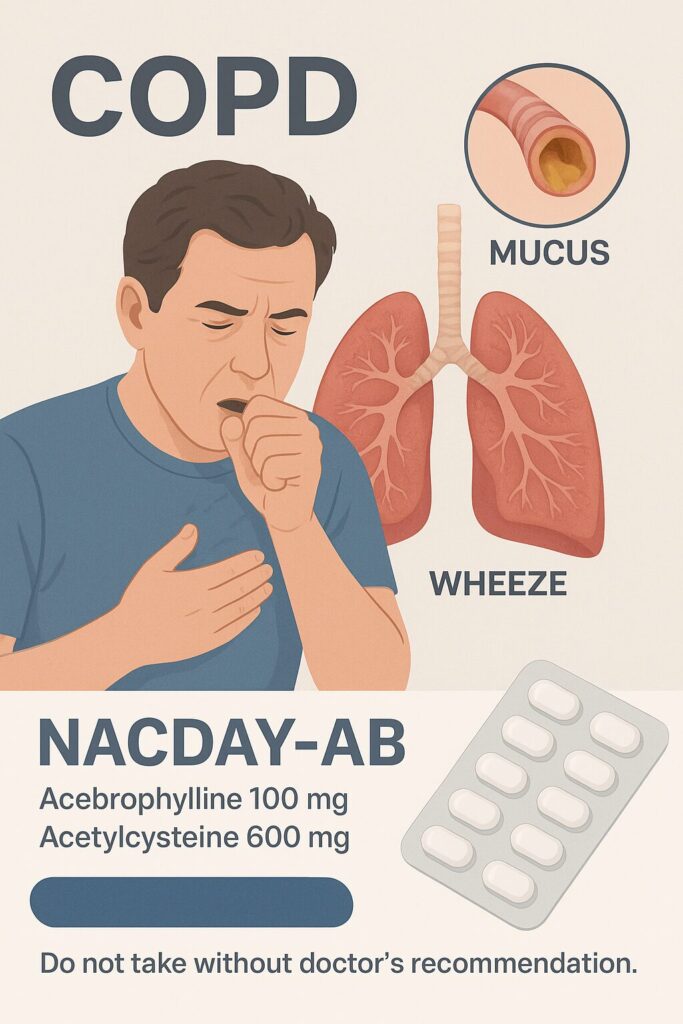
For the millions living with Chronic Obstructive Pulmonary Disease (COPD), each day is a negotiation with their own lungs. It’s a condition defined not just by a diagnosis, but by a relentless duo of symptoms that dictate the rhythm of life: the constant, nagging presence of thick mucus that refuses to be cleared, and the tight, whistling wheeze that makes drawing a full breath feel like a hard-won victory.
If you find yourself planning your day around the location of the nearest sink or trash can, or if you feel a familiar panic when the wheezing starts after a simple walk, you understand this battle all too well.
Traditional approaches often focus on one primary symptom, but what if this strategy is incomplete? Emerging insights into COPD management suggest that attacking both the mucus and the wheeze simultaneously—rather than individually—can break the cycle of decline and offer a new level of control.
This post explores the deep-seated connection between these two tormentors and why a dual-action treatment strategy, such as one offered by medications Nacday-AB tablets containing Acebrophylline 100 mg with Acetylcysteine 600 mg, could be the game-changing approach you’ve been seeking.
More Than Just a Cough: The Double Burden of Mucus and Wheeze
Most people think of COPD as a “smoker’s cough” or simply being short of breath. But for those living with it, the reality is a distinct and exhausting two-front war waged inside the airways.
Let’s break down these two burdens:
- The Burden of Mucus (Chronic Hypersecretion): This is far more than just a minor annoyance. Inflamed airways go into overdrive, producing excessive amounts of abnormally thick and sticky mucus. This isn’t the easy-to-clear phlegm of a cold; this is a glue-like substance that stubbornly clogs the breathing passages. The body’s natural response is to cough—sometimes so violently that it leads to chest pain, dizziness, and even incontinence. This constant effort is draining, both physically and mentally, turning social situations into potential sources of embarrassment and a good night’s sleep into a distant memory.
- The Burden of Wheeze (Airway Obstruction): Wheezing is the sound of air struggling to move through narrowed, inflamed airways. The tiny tubes in your lungs (bronchioles) are constricted and swollen, and the delicate air sacs (alveoli) can lose their elasticity. This combination creates a feeling of tightness in the chest and a desperate hunger for air, even during low-effort activities like getting dressed, making a meal or just sitting idle. It’s a sensation of suffocation that can trigger anxiety, forcing you to limit your activities and retreat from the life you want to live.
Clinically, these aren’t just subjective feelings. The Global Initiative for Chronic Obstructive Lung Disease (GOLD) report acknowledges chronic cough and sputum production (mucus) as key symptoms that often precede the development of significant airflow limitation (wheeze/shortness of breath). Furthermore, research consistently shows that the presence of chronic mucus hypersecretion is a significant predictor of a more rapid decline in lung function over time.
These two symptoms are not independent adversaries. They work together in a destructive partnership, creating a cycle that relentlessly drives the progression of COPD. Understanding this cycle is the first step toward breaking it.
The Vicious Cycle: How Mucus and Wheeze Fuel Each Other?
If you feel like you’re fighting the same battle day after day, it’s because you are. Mucus and wheeze are not just separate symptoms you must endure. Rather, they are partners in a self-perpetuating cycle of decline. So, understanding this loop is crucial to breaking it.
The cycle typically begins with chronic inflammation—the underlying engine of COPD. Now, irritants like smoke or pollution cause your airways to become swollen and irritated. For instance, you can find all news sources reporting how high AQI due to excessive air pollution in Delhi is worsening COPD cases and giving birth to new patients suffering from lung issues. This inflammation due to irritants triggers two simultaneous problems:
- Wheeze: Firstly, the inflamed airway walls thicken, and the muscles around them tighten, causing bronchoconstriction (narrowing of the airways). This is the direct cause of wheezing and shortness of breath. So, you simply have less space for air to flow.
- Mucus: Secondly, that same irritation goads the mucus-producing cells (goblet cells) in your airways into overdrive. So, they produce excessive amounts of thick, sticky mucus as a flawed defence mechanism.
Now, the cycle begins to spin:
Step 1: Mucus Worsens Wheeze.
The thick, sticky mucus acts like a physical plug, further obstructing your already narrowed airways. It’s like a traffic jam in your lungs: even if the roads (airways) are narrowed, the cars (air) can still move slowly, but when you add broken-down vehicles (mucus plugs), everything grinds to a halt. So, this dramatically increases the effort of breathing and intensifies the wheeze.
Clinical Evidence:
Research Study:
A study in the International Journal of Chronic Obstructive Pulmonary Disease highlights that mucus hypersecretion is independently associated with more severe airflow limitation and a higher frequency of exacerbations.
This 2023 review article comprehensively examines the role of mucus hypersecretion in COPD. The authors state that nearly 50% of COPD patients have chronic mucus hypersecretion (CMH), and these individuals have a 3.5-fold higher risk of death compared to those without CMH. The review also confirms that CMH is a main factor contributing to increased morbidity and mortality, and that patients with CMH are more likely to experience frequent and severe exacerbations and reduced lung function. (Source: ttps://pmc.ncbi.nlm.nih.gov/articles/PMC10344637/)
Research Study:
A long-term follow-up study found that chronic airway mucus hypersecretion was associated with an excess decline in FEV1 (a key measure of lung function) of 22.8 mL/year in men and 12.6 mL/year in women, even after adjusting for smoking.
Furthermore, chronic mucus hypersecretion is associated with a significantly increased risk of hospitalisation—2.4 times higher in men and 2.6 times higher in women. Additionally, persistent cough and phlegm increased the overall risk of death by 1.64 times and the risk of respiratory-related death by 2.54 times. (Source: https://pmc.ncbi.nlm.nih.gov/articles/PMC4936458/)
Step 2: Wheeze Worsens Mucus.
Now, here is the frustrating catch-22: the very act of wheezing and having narrowed airways makes it nearly impossible to clear the mucus. A strong, effective cough requires you to be able to take a deep breath and generate enough air flow to propel the mucus upward. But when your airways are constricted, you cannot generate the necessary force. So, the mucus remains trapped, festering in the warm, dark environment of your airways.
Step 3: The Cycle Repeats and Worsens.
Then, this trapped mucus is more than just an obstruction; it’s a breeding ground for bacteria and a continued source of irritation. This leads to recurrent infections and increased inflammation, which in turn tightens the airways further and stimulates even more mucus production. So, the cycle intensifies with each rotation, leading to a rapid decline in lung function and a significantly increased risk of severe, hospitalising exacerbations. Also, research has shown that this vicious cycle directly contributes to worse health-related quality of life and higher mortality rates.
Hence, this self-feeding loop explains why treating only one symptom often leads to incomplete relief. Tackling the wheeze with a bronchodilator may open the airways slightly, but if the mucus plugs remain, the obstruction is still there. Conversely, thinning the mucus with a mucolytic is of limited use if the patient lacks the air flow to cough it out effectively.
So, the key to effective management is to interrupt this cycle at multiple points simultaneously.
Beyond Quick Relief: The Limits of One-Dimensional Treatments
For decades, the cornerstone of COPD management has relied on bronchodilators and corticosteroids. Although these treatments are essential and provide crucial relief, but they often function like a one-tool solution for a two-problem puzzle. They primarily target the wheeze—the bronchoconstriction and inflammation that narrow the airways—but frequently leave the problem of excessive mucus largely unaddressed. (Sources: https://pmc.ncbi.nlm.nih.gov/articles/PMC10732574/ and https://www.mdpi.com/1424-8247/14/10/979)
This one-dimensional approach can lead to a frustrating treatment gap for many patients. Research has consistently shown that patients with the “wheezing phenotype” of COPD—about 39% of the COPD population—experience significantly worse symptoms. They experience more frequent exacerbations, and poorer lung function despite being on standard maintenance treatments. (Source: https://pmc.ncbi.nlm.nih.gov/articles/PMC4603716/)
This suggests that when mucus and wheeze interact in a vicious cycle, focusing on just one component is often insufficient to break it.
Besides, the limitations become clear when we look at the mechanisms:
A bronchodilator may open the airways, but if those passages remain plugged with thick, sticky mucus, the air still cannot flow freely. So, the physical obstruction remains.
Similarly, a mucolytic can help thin the mucus, but if the airways are too constricted and inflamed, the patient lacks the necessary air flow to cough effectively and clear it.
This is where the innovative approach of a dual-action combination like Nacday-AB tablets changes the strategy. Instead of a single tool, it provides a comprehensive toolkit that attacks both sides of the problem simultaneously. The following table breaks down how this dual approach works to dismantle the vicious cycle of symptoms.
| Symptom Target | Active Component | Mechanism of Action | Clinical Benefit |
| Mucus (Hypersecretion & Poor Clearance) | Acetylcysteine 600 mg | A potent mucolytic and antioxidant. So, it breaks the disulfide bonds in mucin proteins, effectively thinning the thick, sticky mucus. | As a result, it makes mucus less viscous and easier to expectorate, reducing cough effort and the risk of mucus-plugged airways and infections. |
| Wheeze (Airway Obstruction & Inflammation) | Acebrophylline 100 mg | Acts as a bronchodilator and muco-regulator. It helps relax and widen the constricted airways while also promoting improved mucociliary clearance—the natural cleaning mechanism of the lungs. | Eases breathing by reducing airway narrowing and helps the lungs’ own mechanisms to clear the thinned mucus more effectively. |
A Dual-Action Strategy: Taking on Two Symptoms with One Treatment
Nacday-AB tablets combination is not merely two drugs in one pill; it is a synergistic strategy designed to work on the two primary, interconnected pathologies of COPD.
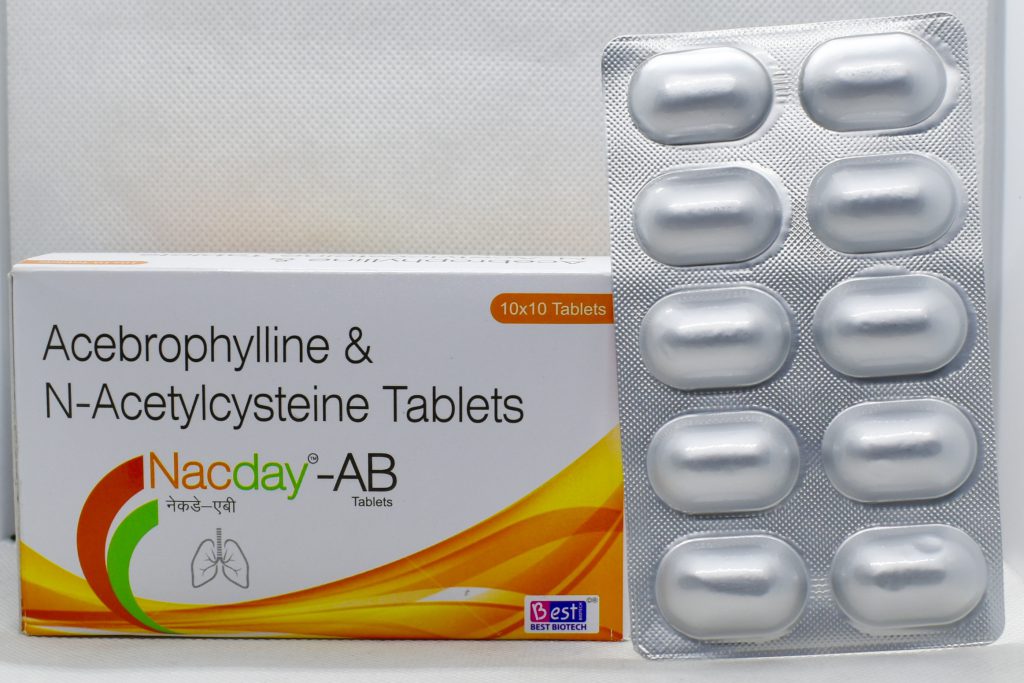
The true power of this therapy lies in the synergy between its two components. By breaking down the physical mucus plugs, Acetylcysteine removes a major source of airway obstruction and irritation. Simultaneously, Acebrophylline works to open the constricted airways and calm the underlying inflammation. This therefore creates a powerful, two-pronged effect:
- It breaks the vicious cycle: With thinner mucus and wider airways, the patient can finally clear their lungs effectively. This reduces the stimulus for further inflammation and infection.
- It restores lung function: Improved mucociliary clearance and reduced bronchoconstriction work together to improve airflow and gas exchange. So, it directly addresses the sensation of breathlessness and wheeze.
The Proof Is in the Patient’s Relief:
The theoretical benefits of a dual-action approach are compelling, but the true measure of any treatment lies in its real-world impact on patients’ lives.
This isn’t just a theoretical advantage. A 2025 post-marketing surveillance study conducted in India specifically investigated this combination therapy as an add-on treatment in patients with moderate to severe COPD. The results were significant: (Source: https://pmc.ncbi.nlm.nih.gov/articles/PMC12126983/)
- Superior Symptom Control: The group receiving Acebrophylline + Acetylcysteine showed significantly greater improvement in key symptoms like cough, sputum production, and dyspnea (shortness of breath) compared to the control group.
- Improved Lung Function: After 90 days of treatment, patients showed a statistically significant improvement in FEV1 (Forced Expiratory Volume in 1 second), a key measure of airway function, from a mean of 1.237 L to 1.414 L.
- Enhanced Quality of Life: Crucially, the study reported a dramatic improvement in quality of life, measured by the COPD Assessment Test (CAT) score, which dropped from 17.2 to 10.6. This represents a major improvement in a patient’s day-to-day life and symptom burden.
Treatment Outcomes:
The effectiveness of this combination is not just measured in laboratory parameters but in tangible, patient-centric outcomes. The following table summarises the key benefits demonstrated in clinical studies:
| Outcome Measure | Demonstrated Benefit | Clinical Significance |
| Lung Function (FEV1) | Significant improvement from baseline. | Indicates better airflow and reduced airway obstruction, directly addressing the “wheeze.” |
| Symptom Scores (Cough, Sputum, Dyspnea) | Marked reduction in severity and frequency. | Translates to less daily discomfort and effort, improving the ability to perform routine activities. |
| Exacerbation Frequency | Reduced rate of acute flare-ups. | Fewer exacerbations mean fewer hospitalizations, less antibiotic use, and slower disease progression. |
| Quality of Life (QoL) | Statistically significant improvement in standardized QoL scores. | Reflects a holistic benefit, where patients feel better and function better in their daily lives. |
By integrating a treatment that targets both critical pathways, it becomes possible to disrupt the destructive feedback loop between mucus and wheeze, offering a more complete and effective management strategy for a complex disease.
This therefore confirms that a dual-action approach does not just manage symptoms in isolation; it provides a more holistic and effective strategy by fundamentally disrupting the pathological cycle that drives COPD progression.
What does this mean for you as someone struggling with COPD?
For the person living with COPD, this data translates into hope for a more normal life. It means:
- Fewer “Bad Days”: Firstly, with a lower risk of sudden flare-ups, you can plan your weeks with more confidence.
- Easier Breathing: Secondly, the combined effect of clearer airways and reduced constriction means less effort is required for every breath.
- Reclaiming Your Time: Finally, less time spent in forceful, exhausting coughing fits means more energy for the activities you enjoy.
This body of evidence solidifies the position of dual-action therapy, such as in Nacday-AB tablets, as a valid and effective strategy for managing the complex symptomatology of COPD, moving beyond simple symptom relief toward comprehensive disease modification.
Is This Approach Right for You? A Conversation to Have With Your Doctor
Managing COPD is not about finding a one-size-fits-all solution, but about building a personalised treatment plan that addresses your unique symptoms and lifestyle. The dual-action approach of targeting both mucus and wheeze with a medication like Nacday-AB tablets represents a significant advancement in this personalised strategy. However, it is a tool best used under expert guidance.
If you consistently struggle with the dual burden of difficult-to-cough mucus and persistent wheezing or breathlessness, despite your current medication, this approach may be a relevant option to explore. It is particularly suited for patients where mucus hypersecretion is a dominant issue, as this is a key predictor of exacerbations and declining lung function.
Your Next Step: An Informed Conversation
We encourage you to take an active role in your healthcare. Here is how you can start this conversation with your doctor:
Be Specific About Your Symptoms: Instead of saying “I’m feeling worse,” try to describe your experience in detail. For example: “I’m having a lot of trouble clearing mucus in the mornings, and I get wheezy even when walking slowly.”
Discuss Your Goals: Share what “better” looks like for you. Is it being able to walk to the market without stopping? Is it sleeping through the night without coughing fits?
Ask Informed Questions: You can now ask targeted questions like:
“Given my issues with both phlegm and tightness in my chest, would a treatment that addresses both mucus and airway constriction be suitable for me?”
“I read about combination therapies like Acebrophylline and Acetylcysteine. Based on my condition, what are the potential benefits and considerations?”
A Final, Important Note
It is crucial to remember that WIKLYONE may be a suitable medicine for a diabetic needing a DPP4 inhibitor but not for someone needing another medicine class. Similarly, the Acebrophylline and Acetylcysteine combination is a specific tool for a specific set of problems in COPD.
It is not a replacement for all other therapies and may not be appropriate for every patient. Your doctor is the only person qualified to evaluate your overall health, the severity of your COPD, and your other medications to determine if this treatment aligns with your comprehensive care plan.
Empower Yourself Through Dialogue
Taking control of your COPD begins with a conversation. By understanding the vicious cycle of symptoms and the modern treatment strategies designed to break it, you can partner with your doctor to find a path toward more stable breathing and a better quality of life.
Disclaimer: This blog post is for informational purposes only and does not constitute medical advice. The information is intended to help you have a more informed discussion with your healthcare provider. All treatment decisions must be made in consultation with a qualified medical professional who understands your individual health status. Do not start or stop any medication without the direct advice of your doctor.
Nacday-AB tablets are available for distribution across India through pharma PCD and pharma franchisee business opportunities. If you are looking forward to adding an Indian brand of Accebrophylline 100 mg with Acetylcysteine 600 mg tablets in your pharmaceutical sales portfolio, feel free to contact our pharma PCD helpdesk, asking for business opportunities for Nacday-AB tablets in unrepresented areas. Let’s partner together and make quality healthcare accessible and affordable to all in need, just what we at Best Biotech strive to achieve.
Quick Links:
- Inspicare Products
- Why Pharma Exhibitions Matter: 9 Top Reasons to Attend Next Pharma Expo
- Can WIKLYONE (Trelagliptin) Reduce the Diabetes Burden in India?
- The Root of It All: Why Your Fork is Mightier Than Your Hairbrush for Healthy Hair?
- Pharma Franchise & PCD Opportunity: Market WIKLYONE, the Future of Diabetes Management
3 Responses