
Contents of This Post:
- What is WIKLYONE (Trelagliptin)?
- Why does once-a-week dosing matter?
- How WIKLYONE (Trelagliptin) works?
- Why does a once-weekly pill (WIKLYONE) work?
- Is WIKLYONE the best diabetes medicine: the one you always wanted?
Looking for a diabetes treatment that fits a busy life — without sacrificing safety or effectiveness? WIKLYONE (Trelagliptin) is a once-a-week medicine for diabetes that’s getting attention for exactly that reason. If you’ve wondered whether a weekly pill can really control blood sugar as well as daily medicines, this guide explains in simple terms how Trelagliptin works, why once-a-week dosing is possible, and who might benefit.
What is WIKLYONE (Trelagliptin)?
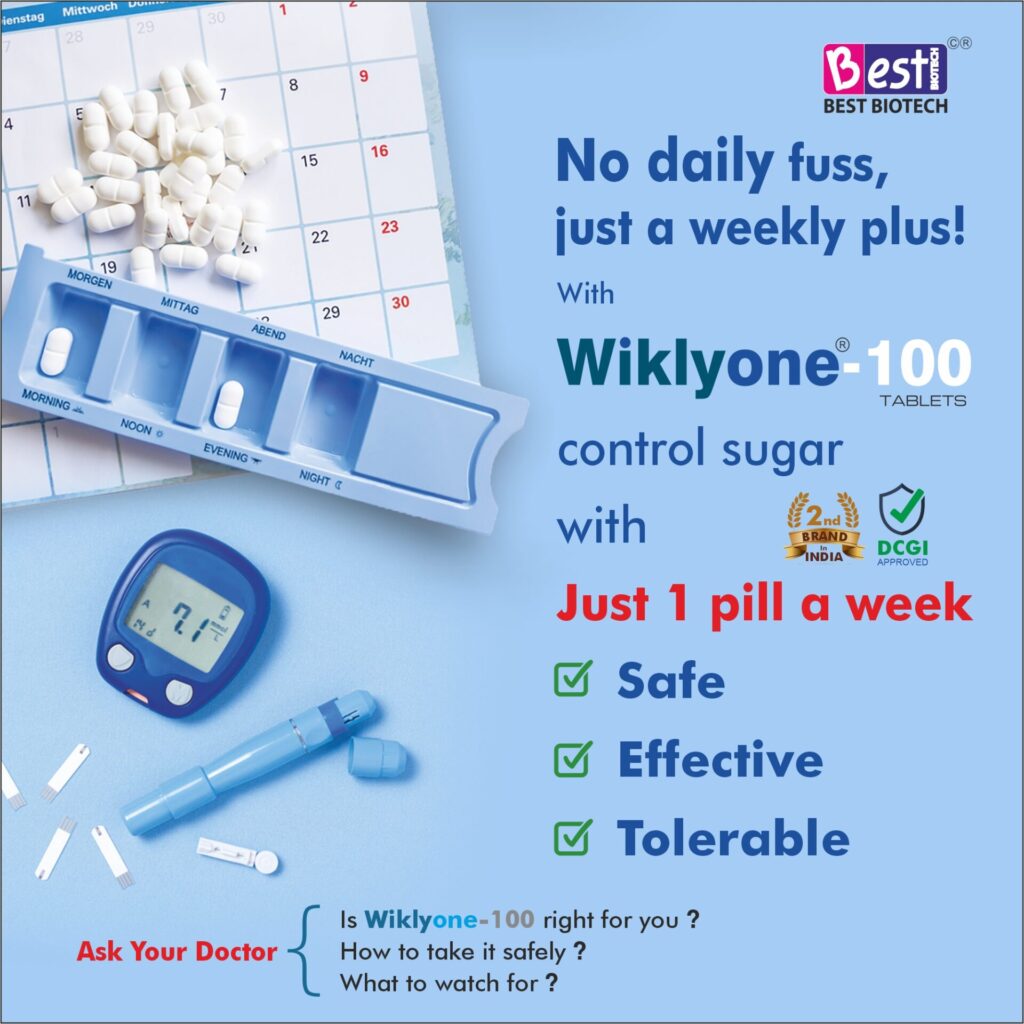
WIKLYONE (Trelagliptin) is a once-a-week medicine for diabetes that offers a modern alternative to daily oral treatments for type 2 diabetes. It belongs to the DPP-4 inhibitor class, which helps the body utilise its own hormones to regulate blood sugar levels after meals. Instead of supplying insulin directly, this type of drug prolongs the action of incretin hormones so the pancreas releases insulin when the body needs it and the liver makes less sugar between meals.
Why do people consider WIKLYONE?
Firstly, it provides the convenience of once-weekly dosing, which can improve adherence for busy lives. Secondly and more importantly, it targets post-meal glucose rises as well as fasting blood sugar through incretin support.
Doctors often consider it when patients prefer fewer doses or struggle with daily medication routines.
WIKLYONE does not replace lifestyle steps, such as a balanced diet and regular exercise. Many patients see good glucose control when they combine medication, healthy habits, and regular monitoring.
Once-a-week dosing changes how many people live with diabetes. Instead of remembering a pill every day, patients take one tablet weekly — a small change that often makes a big difference in real life. For many people, fewer doses mean fewer missed pills, simpler routines, and less “medication fatigue.” That can directly improve long-term control in a chronic condition like type 2 diabetes.
Many people leave the treatment and often rely on unproven, usually social-media-influenced remedies for treating diabetes. They look for simpler remedies, often because they are tired of taking medicines every day. Psychologically, they say, they feel ‘patient-like’ when they have to pop in daily pills. So, a simple step-down of pill count can improve patient outcomes by giving them both ‘sugar control’ as well as ‘less medicine dependency’.
Non-adherence to diabetes medicine is not as small as you may think.
The challenge of medication non-adherence is a critical and often overlooked public health crisis. Robust data from organisations like the World Health Organisation (WHO) consistently show that across chronic illnesses, approximately 50% of patients do not follow their prescribed medication regimens. This is not a simple case of forgetfulness; it is a complex issue influenced by factors such as treatment cost, complex dosing schedules, side effects, and a lack of perceived immediate benefit.
This failure to adhere has dire consequences. Medication does not simply “not work” when taken inconsistently; it can actively contribute to the progression and worsening of the underlying disease. For conditions that require steady, consistent management, sporadic medication creates a rollercoaster effect within the body. This suboptimal control allows the disease to damage systems unchallenged, often leading to more severe presentations, complications, and a lower quality of life.
Diabetes mellitus is a quintessential example of this danger. It is often termed a ‘silent killer’ because its initial progression is frequently asymptomatic. A patient may not feel immediate pain or dramatic symptoms from high blood sugar, creating a false sense of security. This perceived lack of urgency is a major contributor to non-adherence.
However, during this “silent” period, persistent hyperglycemia is relentlessly causing microvascular and macrovascular damage. The effects are systemic and insidious:
Cardiovascular System:
It accelerates atherosclerosis, dramatically increasing the risk of heart attack, stroke, and peripheral artery disease.
Renal System (Nephropathy):
It damages the delicate filtering units of the kidneys, which can lead to end-stage renal disease requiring dialysis or transplantation.
Retinal System (Retinopathy):
It harms the blood vessels in the retina, which is a leading cause of blindness in adults.
Neuropathy:
It causes nerve damage, leading to pain, numbness, and an increased risk of foot ulcers and amputations.
The tragedy is that these severe, life-altering complications are largely preventable through consistent glycemic control. However, when medication adherence is poor, this control is never achieved. The damage accumulates silently, often only being diagnosed after it has become advanced and irreversible. Therefore, consistent adherence to prescribed therapy is not merely about taking pills; it is a fundamental defence against the silent, progressive damage of chronic conditions like diabetes.
WIKLYONE (Trelagliptin) offers a simplified solution to non-adherence to the treatment and can improve patient outcomes drastically by keeping better control and preventing complications. T2DM is on the rise, and hence, it is important to come up with innovative solutions that can prevent complications conveniently.
Practical benefits:
- Better adherence: Taking a medicine once a week fits busy schedules and travel plans.
- Lower daily burden: Patients feel less burdened by treatment, which improves persistence with therapy.
- Simpler counselling: Caregivers and healthcare teams find it easier to track adherence when dosing is weekly.
- Fewer dosing errors: Weekly dosing reduces the chance of accidentally doubling daily doses or missing doses.
Who might benefit most?
- People with hectic lives or irregular routines.
- Those who struggle to remember daily pills.
- Older adults or caregivers managing multiple medicines.
- Patients who prefer fewer tablets but still want oral diabetes treatment options.
Things to consider:
- Weekly dosing does not replace healthy habits. Diet, activity, and glucose monitoring remain essential.
- One weekly tablet does not suit everyone. Your doctor will consider kidney function, other medicines you take, and any medical conditions before recommending Trelagliptin.
- If you miss the weekly dose, follow your prescriber’s instructions — do not guess.
- Cost, availability, and insurance coverage may differ from daily medicines, so check these before switching.
Once-a-week Trelagliptin aims to make diabetes treatment easier without changing the goal — stable blood sugar and fewer diabetes complications. Talk to your healthcare provider to see whether a weekly medicine fits your treatment plan and lifestyle.

How WIKLYONE (Trelagliptin) works?
WIKLYONE (Trelagliptin) helps your body use its own hormones to control blood sugar — it does not force insulin into your body. After you eat, your gut releases incretin hormones (mainly GLP-1 and GIP). These hormones tell the pancreas to release insulin when blood sugar rises and tell the liver to reduce sugar output between meals. A naturally occurring enzyme called DPP-4 chops up those helpful hormones so their effect wears off.
Trelagliptin blocks DPP-4, so incretins stay active longer. The longer incretins work, the more your pancreas releases insulin only when your blood sugar is high, and the more your liver holds back on making extra sugar. That combination lowers both post-meal spikes and fasting glucose without forcing insulin at inappropriate times.
Key points, simply put:
- Trelagliptin prevents the breakdown of incretin hormones (GLP-1, GIP).
- It boosts insulin release in a glucose-dependent way — insulin rises when blood sugar rises, lowering the risk of low blood sugar compared with some other drugs.
- It reduces glucagon (the hormone that raises blood sugar) and cuts liver sugar production.
The net result: better overall blood-sugar control, especially after meals.
Why does a once-weekly pill (WIKLYONE) work?
Pharmaceutical scientists designed Trelagliptin to remain active in the body far longer than daily DPP-4 inhibitors. That extended activity keeps DPP-4 suppressed over seven days, so the drug delivers steady incretin support from one dose each week. In everyday terms, one well-timed tablet can give continuous enzyme blocking for a full week, which explains how weekly dosing can still control blood sugar effectively.
That sustained action can improve adherence (people are more likely to take medicine that fits their routine) while preserving effectiveness — but it’s not necessarily the best choice for everyone. If you want to know whether Trelagliptin fits your diabetes treatment plan, discuss it with your healthcare provider — they can weigh the benefits, safety, and how it compares with other diabetes medicines.
Is WIKLYONE the best diabetes medicine: the one you always wanted?
WIKLYONE (Trelagliptin) offers a practical, once-a-week option in the evolving landscape of diabetes treatment. The science on ‘how Trelagliptin works’ underpins why a single weekly medicine for diabetes can still deliver steady blood-sugar support.
For many people, once-weekly dosing improves adherence, reduces daily pill burden, and simplifies long-term care. Still, this option does not suit everyone. Your doctor will weigh factors such as kidney function, other medicines you take, treatment goals, and cost or access before recommending Trelagliptin.
If you want a diabetes medicine that fits a busy life without compromising safety, ask your healthcare provider whether WIKLYONE could work for you. Bring your recent blood-sugar readings, a list of current medicines, and any concerns so the diabetes doctor can make a personalised plan.
Curious to learn more? Reach out to our Diabetes Care team to get the clinical highlights or speak with your pharmacist or physician for tailored advice on starting or switching to Trelagliptin.
7 Responses